NewStori...First & Foremost A Quality News Outlet!
As warming conditions create new operating pathways in the Arctic and military training increasingly emphasizes proficiency in the cold, the Army Corps of Engineers’ Engineer Research and Development Center is preparing to open a state-of-the-art center supporting research at its permafrost tunnel research facility.
A new $11.4 million operations center, next to the tunnel in Fox, Alaska, is set for completion this year and formal opening in early 2026, Gary Larsen, the facility’s operations manager, told Military Times in an interview.
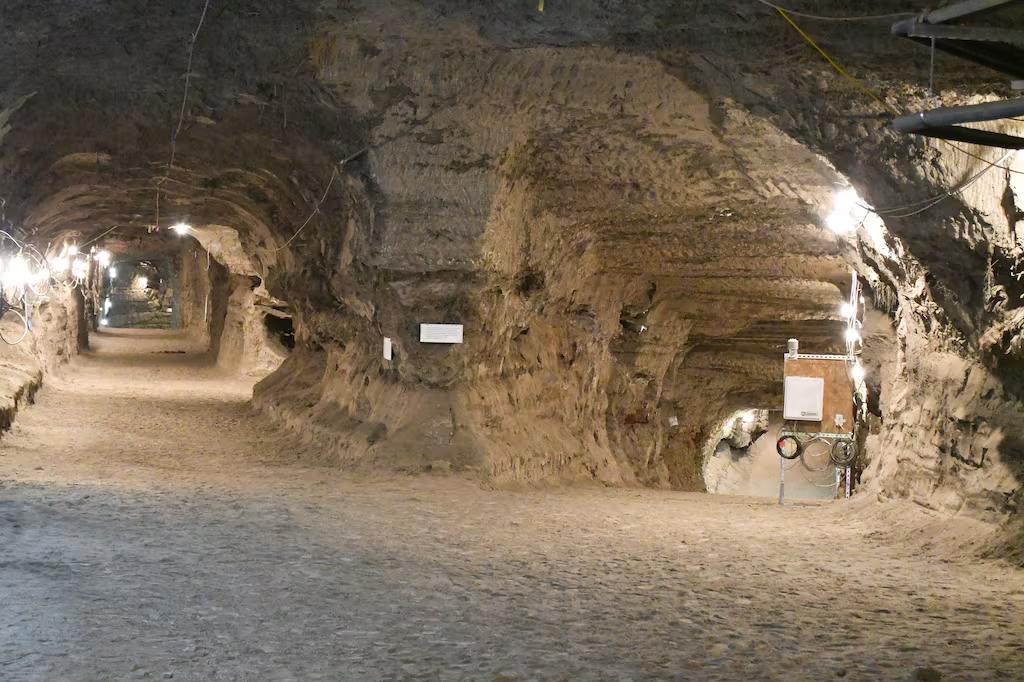
The tunnel itself — about a third of a mile long and 14 feet wide and high, with Ice Age-era animal bones jutting out from the walls — is one of the Corps’ little-known marvels, dating back to the 1960s.
The tunnel’s permafrost, defined as any ground or soil that remains frozen for at least two years straight, is used by scientists to study questions ranging from how thawing microbes trapped in layers of ice and earth might affect soldiers’ health, to how to build sound military structures in and on the material.
And these are not abstract questions — an F-35A hangar project at Eielson Air Force Base, Alaska, that concluded last year required engineers to excavate warm permafrost while maintaining the integrity of the hangar’s foundation.
The reality of increased permafrost thaw in the north has forced military units to confront questions about the health impacts of microbes that may be tens of thousands of years old, but still living when they thaw at the surface.
“The question has come up from the command here at the 11th Airborne [Division out of Joint Base Elmendorf-Richardson, Alaska]: ‘What are we potentially exposing our soldiers to, anyway?’” Larsen said. “There’s a whole, much broader kind of work that we do.”
The new operations facility, Larsen said, will cover about 4,000 square feet and include a visitor center with indoor bathrooms, a luxury not currently available to staff and scientists; a lab facility for processing samples on-site, rather than at the existing lab facility in Fort Wayne, more than 10 miles away; and a “warm room” for storing equipment, batteries and vehicles away from the punishing cold.
“We’re spectacularly blessed that we actually get a permanent building out there now,” Larsen said. “Now, [scientists] can actually process their samples out there; they can store them. They can do some rudimentary lab analyses out there at the new building. ... It’s all really cool.”
The tunnel, which began excavation in 1963, started as a Cold War bunker project, eventually abandoned, to protect personnel and weapons systems from attack, Larsen said.
“This permafrost … it’s not brittle. It deals well with vibration,” he said. “The idea is ... you put something in there, and they bomb the hillside. It doesn’t collapse, and there’s not a lot of vibrations in it.”
While the bunker project eventually ran out of money and was halted before military equipment was ever stored there, the tunnel has proved its resilience in the decades since, surviving multiple earthquakes, Larsen said.
During construction of the new operations facility last summer, he said, heavy equipment operations that rocked the cabin currently serving as a makeshift visitor center couldn’t even be felt inside the tunnel.
“It’s kind of funny that this new construction project actually helped validate the original purpose for digging the tunnel,” he said.
As military interest in extreme-cold combat operations increases in light of competition for supremacy in the Arctic and focus turns toward frigid-weather adversaries, such as Russia and North Korea, Larsen said research and experimentation in the tunnel and at the surface of the permafrost has for the most part remained steady.
He has, however, noticed an increase in visits from VIPs, public officials and military units seeking to understand the realities of cold-weather military competition.
The new visitor center, Larsen said, will help advance the facility’s educational mission.
Alaska-based military units, he said, are “actually now doing leadership development programs in the tunnel, learning about permafrost and what it is and how that impacts their operations. It’s a basic thing that we would be teaching them, but it’s become increasingly important.”
The tunnel also presents a unique opportunity for special operations units and other military elements to drill on subterranean operations, another point of increasing focus for the Defense Department as leaders anticipate fighting more in urban environments.
While the units can’t execute live fire in the tunnels, Larsen said, they can use it as a familiarization range for personnel and accompanying machines and equipment. The tunnel played a role, he said, in Arctic Edge 24, a joint homeland defense exercise led by U.S. Northern Command last year.
“It helps the Special Forces guys learn how to operate in these environments that they normally wouldn’t get a chance to operate in,” Larsen said. “It’s cold in there. It’s dusty in there. When we turn the lights off, it’s dark in there. It’s kind of fun.”
To date, the tunnel has had only one visit from a sitting president — Jimmy Carter in 1981 — but lawmakers often request to visit while they’re in the region.
“Sitting in D.C., it’s kind of hard to understand exactly what permafrost is and how that impacts life up here, and more importantly, in this context, operations for the military,” Larsen said. “Just being here at the tunnel for an hour, in the operations facility, and then in the tunnel, all of a sudden you see the light go on. And it helps them.”

Google Chrome users are facing a new cyber threat that uses drive-by download attacks. This strategy targets people who want to download the Google Chrome web browser app. It could put malware on their systems.
Security experts are telling users to be careful when they download things. Shmuel Uzan has reported on a new malware called ValleyRAT. It uses phishing emails, bad websites, and instant messaging to trick users into downloading it.
In a recent attack, the threat actors made a fake website that looked like a Chinese telecom company to spread the malware. Jamie Akhtar, CEO at CyberSmart, said these attacks are getting more advanced and targeted. The campaign focuses on finance, sales, and accounting workers because they have access to sensitive data.
Akhtar said this technique will likely be copied and used to target Western companies. He told people to be careful when downloading software tools. Erich Kron from KnowBe4 said it’s important to only download software from real publisher sites.
He warned that malware on other sites and in ads can be very effective. Kron said taking steps to stay safe is crucial, especially for popular software like Google Chrome.
Chrome users also need to watch out for security holes in the browser. These affect Android, Linux, macOS, and Windows systems. Some major issues are:
– CVE-2025-0444: A high-rated problem in the Skia browser part.
– CVE-2025-0445: A high-rated issue in Chrome’s V8 JavaScript engine. – CVE-2025-0451: A medium-rated problem in the Extensions API. Google has released a new ChromeOS version, 126.0.6478.264, to fix more security holes:
– CVE-2025-0437: An out of bounds memory read issue in Metrics.
– CVE-2025-0438: A stack buffer overflow in Tracing. To stay safe, users should keep Chrome and their operating systems updated. Google does a lot of this automatically, but users can check for updates in the Help|About Google Chrome menu.
Cybersecurity experts say users, especially those with sensitive data, need to stay alert. The key steps are to make sure downloads are from real sources and to keep software up to date.