NewStori...First & Foremost A Quality News Outlet!
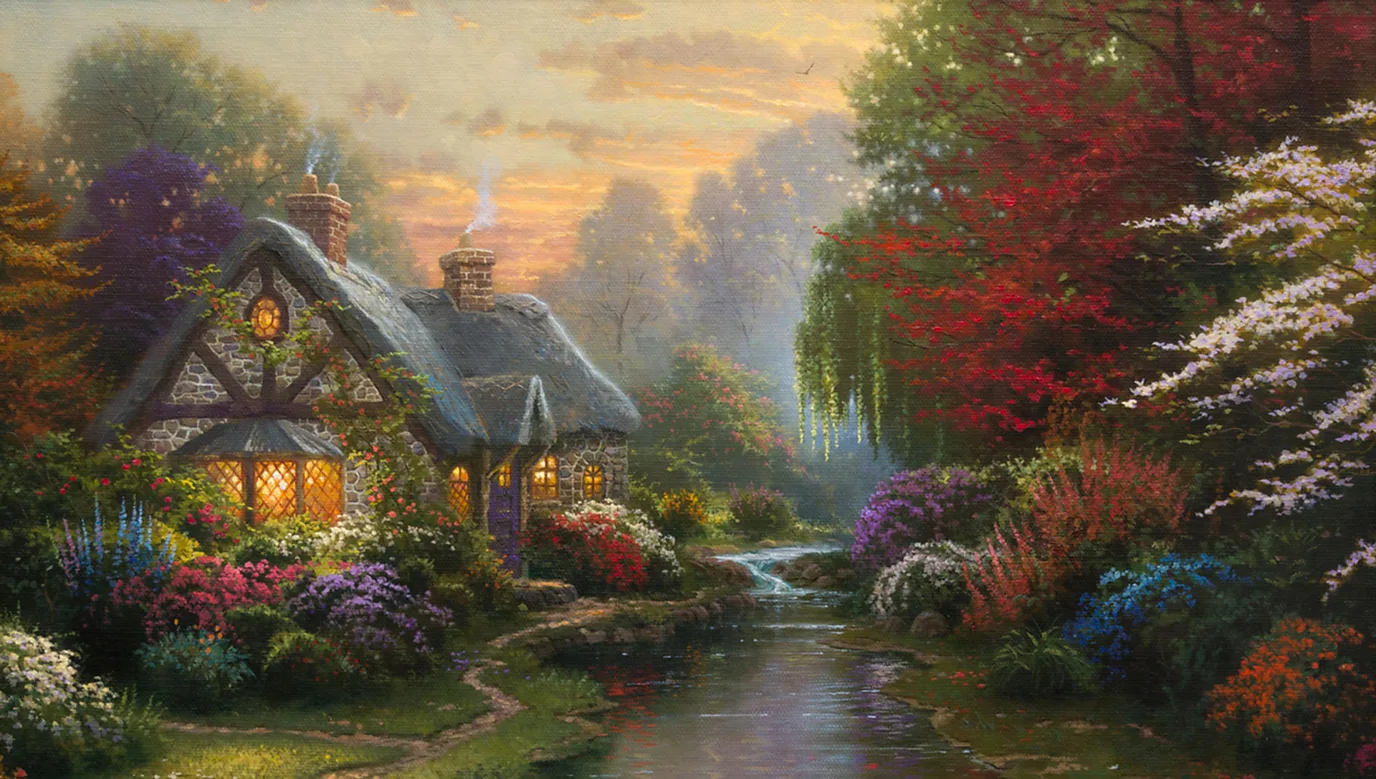
Beloved by many, despised by others, Thomas Kinkade's quaint rustic scenes and his wholesome image belied a dark and tortured story that contrasts with his 'sugary' artworks.
Thomas Kinkade was one of the best-selling artists in history, as well as one of the most divisive. When he died in 2012, the American painter had been rocked by business problems, but at his commercial peak a decade earlier, his company was bringing in more than $100m a year. And yet his work was despised by many critics – not because it was blasphemous or obscene, but because, well, he specialised in quaint pictures of thatched-roof rural cottages nestling in leafy groves. "Thomas Kinkade's style is illustrative saccharine fantasy rather than art with which you can connect at any meaningful level," Charlotte Mullins, the author of A Little History of Art, tells the BBC. "It is schmaltzy pastiches of Disney-style woodland scenes, complete with cutesy animals and fairy tale cottages. They are… like the images you find on cheap greetings cards – sugary and forgettable." And compared to some critics, Mullins is being polite.
These critics don't just consider Kinkade's paintings to be nauseatingly sickly, they detect something disturbing and ominous about them. In her 2003 book on California, Where I Was From, Joan Didion summed up his art by saying. "It typically featured a cottage or a house of such insistent cosiness as to seem actually sinister, suggestive of a trap designed to attract Hansel and Gretel. Every window was lit, to lurid effect, as if the interior of the structure might be on fire." As harsh as that sounds, Didion may have been more perceptive than she realised. Art for Everybody, a new documentary directed by Miranda Yousef, shows that the man who called himself the "Painter of Light" did indeed have a dark side. "His branding was so effective that you didn't know there was this really complicated and I would say tortured artist behind it all," Yousef tells the BBC. "He lived a Greek tragedy of a life."
The documentary features audio tapes recorded by Kinkade when he was a long-haired, bohemian-looking art student in California in the 1970s – and even then, he was already fretting over the question of whether he could make an impact as an artist while making a decent living. After a stint in Hollywood, painting backgrounds for Ralph Bakshi's 1983 animated feature film, Fire and Ice, he concentrated on idealised, nostalgic American landscapes, and he and his wife Nanette sold reproductions of them outside a local grocer's shop. In the 1990s, he took the idealism and the nostalgia to new heights, and swapped his rugged vistas for soft-focus pastoral scenes that a Hobbit might deem a bit on the twee side. Old-fashioned lampposts and cottage windows glowed. Streams twinkled beneath slender stone footbridges. Bushes burst with pastel flowers. And cash registers rang. Kinkade didn't sell the paintings themselves, but the hazy idylls they depicted were soon being printed on collectible plates advertised in newspapers and magazines. For many Americans, they were comforting refuges from the modern world.
In Art for Everybody, Christopher Knight, the art critic of the Los Angeles Times, is contemptuous of Kinkade's imagery. "It's a cliché piled upon a fantasy piled upon a bad idea," he says. "The colour is juiced and the light coming from inside those cottages is intense and blaring." Just as importantly, as far as his critics were concerned, Kinkade's pictures had nothing to them beyond their superficial decorative qualities. "They are banal and hollow, with no intent to say anything meaningful," says Mullins. "Today we would think they had been produced by AI – designed as if by algorithm to a certain formula." But Yousef insists that Kinkade's skill can't be discounted. "There were actually other people who were painting cottages and Christmas scenes and putting them on plates and all that stuff," she notes, "and the thing is that Kinkade's were so much better. His works just blew everybody else's out of the water."
She also believes that Kinkade's paintings, rather than being wholly market-led, were linked to his childhood in Placerville, California, where he was raised by his single mother and only intermittently saw his violent father. "It's a common criticism that his cottages look like they're on fire on the inside. And then you learn that it was because when he was growing up it was always cold and dark in the house when he got home, because they didn't have the money to keep the heat and the lights on. He was painting the thing that he wanted."
Kinkade's deprived upbringing, says Yousef, didn't just inspire his choice of subject matter, but drove him to make as much money as he could. He and his business partners printed pictures on an industrial scale, as well as putting his immediately recognisable imagery on furniture and ornaments, and selling them on the QVC shopping network. They also set up hundreds of faux olde worlde Thomas Kinkade Signature Galleries in shopping malls around the US, and trademarked the "Painter of Light" brand. Again, Yousef doesn't see Kinkade as entirely calculating. Having grown up in a house with no pictures on the walls, "He sincerely believed that art should be accessible to everyone."
Behind the fantasy
Whatever you thought of the paintings, the mass-marketing of the work of a single artist was certainly groundbreaking. In interviews at the time, Kinkade asserted that he was no different from an author selling stacks of novels or a musician selling CDs. He even declared that by industrialising his output, he was doing what Andy Warhol had always dreamt of. But Mullins argues that Kinkade was being "obfuscatory and disingenuous" by churning out reproductions by the thousand, paying his assistants to add a few dabs of paint here and there, and then selling these prints for thousands of dollars, as if they were rare and precious works of art. "Prints offer an affordable way of buying art by great artists," she says. "They retain their value through the limited nature of the edition. This was never Kinkade's strategy."
Still, this sort of disagreement between Kinkade and his critics was one of his selling points. Art for Everybody features news reports and promotional videos, in which he tells adoring audiences that his art could be understood and appreciated by everyone, whereas only the snooty elite could see anything artistic about Chris Ofili putting elephant dung on his canvases, or Tracey Emin presenting her unmade bed to gallery-goers. "This is not legitimate art," he proclaimed. As much a televangelist as a painter, Kinkade was a born-again Christian who assured his devotees that buying his work put them on the right side of a political and spiritual line separating them from decadent metropolitan tastemakers. He trademarked the sobriquet "Painter of Light", not just because of all the sunlit clouds and fiery cottages in his pictures, but to signify that he was a force for virtue and Christianity. "The art world is a world of darkness today," he thundered. He, in contrast, was "someone who stands up for family and God and country and beauty". A doughy, plaid shirt-wearing fellow with a thick moustache, he often appeared on television with his blonde wife and his four blonde daughters: the embodiment of wholesome, traditional, all-American values. His fans weren't just paying for his pictures; they were paying to associate themselves with this proudly conservative persona.
But that persona, like the pictures themselves, was more a fantasy that Kinkade wished for than an accurate representation of reality. He was prone to swearing after the directors of his mawkishvideos called "cut". He relied on alcohol to cope with work pressures. And, in the documentary, his daughters say that they were encouraged to smile in videos and personal appearances, but often felt as if their father cared more about his career than about them. "Thomas Kinkade and his persona and his brand really cast an extraordinarily long, dark shadow over his entire family," says Yousef, "and there was a lot wrapped up in perpetuating the brand and preserving it."
Unalaska Island in the remote Aleutian archipelago was part of an epic, but now mostly forgotten, military campaign during World War Two.
Situated where the northern Pacific Ocean meets the Bering Sea, the remote US island of Unalaska straddles the liminal zone where North America transitions into Siberia. The island lies further west than Hawaii; its position on the cusp of East Asia makes it one of Alaska's more remote and idiosyncratic communities.
Part of the Aleutian Islands, a 1,100-mile volcanic archipelago that curves in a westward arc to within 600 miles of Russia's Kamchatka Peninsula, Unalaska features one of the harshest environments on the planet outside the polar regions. The windswept coastlines are rugged, often precipitous and almost entirely devoid of trees.
Because of the Aleutians' location in the Pacific Ring of Fire – one of the world's most seismically active areas – earthquakes are ubiquitous, and half of the island chain's 70 volcanoes, including Unalaska's active Makushin volcano, have erupted in the last 250 years. "Cradle of Storms" and "Birthplace of Winds" are two well-deserved nicknames among locals for the Aleutians. Conflicting weather systems generated in neighbouring seas result in cyclonic storms, hurricane-force winds, heavy rain and dense fog that have a considerable impact upon weather across much of Canada and the continental US.
Today roughly 4,200 people call Unalaska home, including fishermen and the Indigenous Unangax? people (pronounced Oo-Nung-akhh). Also referred to as the Aleuts, the Unangax? have lived in the archipelago and parts of the Alaska Peninsula for at least 9,000 years, creating a subsistence lifestyle that drew upon every resource that the land and sea offered. But over the past several centuries, the Unangax? population has plummeted due to disease and the gradual attrition of their culture that came on the heels of colonialism. Today there are around 2,000 Unangax? in Alaska and the Aleutian Islands.
Yet, this wind-battered island has historically been home to another very different group of peoples who also migrated across what is now the Bering Strait: Russians.
After Danish explorer Vitus Bering and his Russian colleague Alexei Chirikov became the first-known Europeans to visit the Aleutian Islands in 1741, waves of Russian fur traders flocked to the archipelago to hunt sea otters and fur seals. After establishing a Russian settlement on Unalaska in 1759, the islands officially became a colony of the Russian Empire in the late 1700s. Today many inhabitants still have Russian surnames. The Russian Orthodox Church followed the fur hunters, building small houses of worship across the islands and converting many Unangax? to their faith.
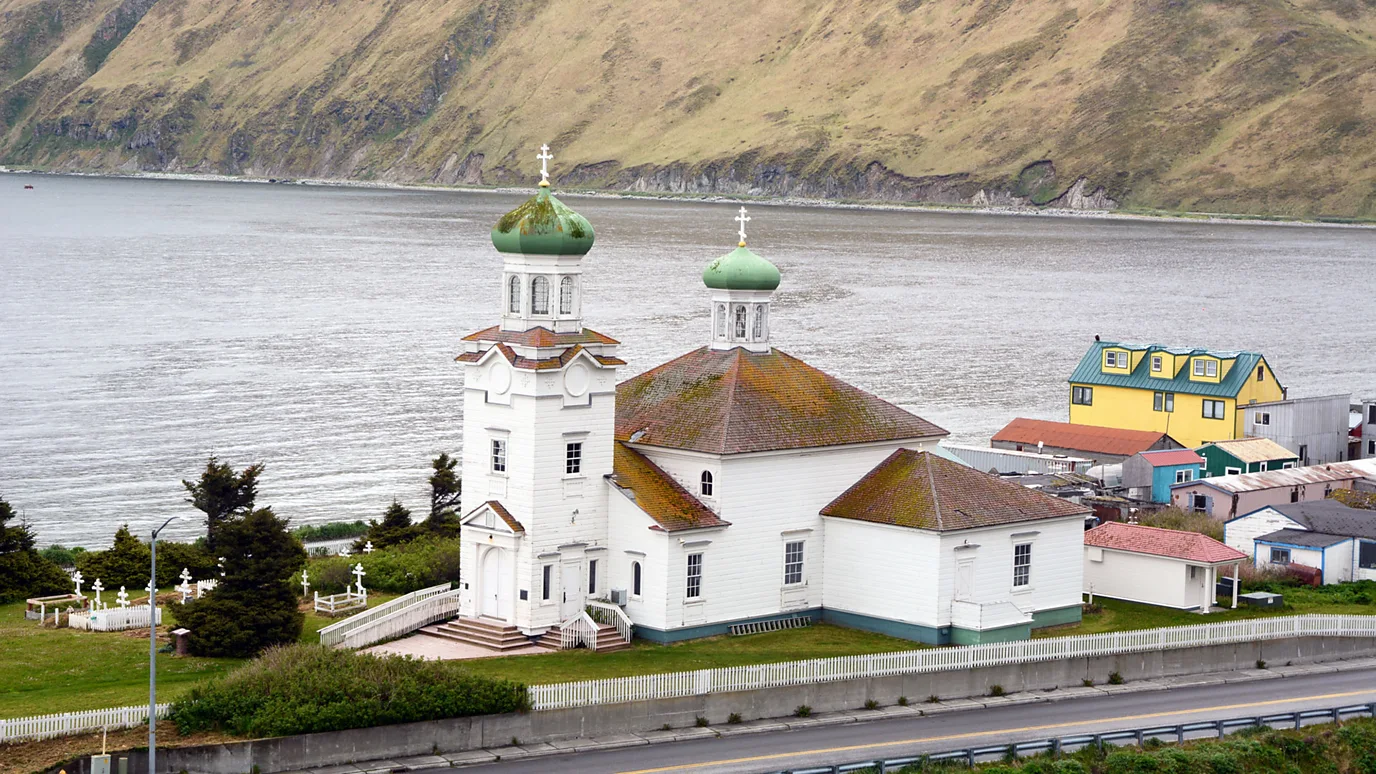
Although the US gained control of the Aleutian Islands when it purchased Alaska from Russia in 1867, the Russian Orthodox legacy has survived. Unalaska's Church of the Holy Ascension is one of a few Russian Orthodox houses of worship that remain. Rebuilt atop its original 1824 location in 1896, it is the oldest cruciform-style Russian Orthodox cathedral in North America, and contains one of Alaska's greatest collection of Russian artefacts, religious icons and artworks – including some that were donated directly from Catherine the Great.
Before the arrival of the current Russian Orthodox priest, reverend Evon Bereskin was Unalaska's sole Christian Orthodox priest and the keeper of the Church of the Holy Ascension from 2013 to 2023. A member of the Unangax? community, he oversaw all the parishes in the Aleutian islands.
"I am constantly in awe of the fact that I [was] the custodian of this incredible relic building," he told me. "It [was] an unbelievable honour and responsibility."
As head of the church, Reverend Bereskin raised funds to restore the church and its icons, which had suffered at the hands of time and the elements. He also changed the liturgy of his services to English (from the Unangax? language and old Slavonic) to make services more accessible to worshippers.
Prior to World War Two, the US had a modest commercial and military presence on the Aleutian Islands, which, lying relatively close to East Asia, were vulnerable to attack after Japan bombed Pearl Harbor. On 3-4 June 1942, planes from two Japanese aircraft carriers attacked Dutch Harbor in the town of Unalaska on the island's northern coast, killing 50 people. Several days later Japanese forces invaded Kiska and Attu islands, the westernmost islands in the Aleutians (670 and 850 miles from Unalaska, respectively), in an attempt to inflict a psychological blow and divert US forces from the Central Pacific theatre, where the Battle of Midway Island was about to take place. It was the first invasion of US soil since the British incursions in 1812. The SS Northwestern, a passenger and freight steamship used by the US Navy in the war, was destroyed in the Japanese attack on Dutch Harbor. Its rusted hull still rises above the water's surface, a ghostly reminder of a bloody battle.
Within months of the Dutch Harbor attack, 145,000 US and Canadian soldiers were deployed to defend and retake the occupied Aleutians. They secured the islands with fortresses, artillery and bunkers, such one on Bunker Hill above Dutch Harbor, which is now the setting of a hike with stunning 360-degree views. A larger base overlooking Unalaska Bay and the Bering Sea a few miles away on nearby Mount Ballyhoo, known as Fort Schwatka, once featured 100 buildings and was built to withstand earthquakes and hurricane-force winds. Epic, harrowing battles were fought on bleak and difficult terrain. Thousands died on both sides of the conflict – many from exposure to the islands' harsh weather. By August 1943, the Japanese were expelled from the Aleutians, and over time, the battles that took place here have been largely forgotten.
After the Japanese attacks, the US military ordered the mandatory evacuation of the Unangax? from the Aleutians for their safety and to prepare the island for arriving military forces. Residents were given less than a day's notice, allowed one suitcase each and weren't told where they were going or when they would return. In all, 881 Unangax? were expelled from nine villages across the archipelago and were interned at abandoned canneries in the temperate rainforests of south-eastern Alaska for three years. Many had never left their homeland before, let alone seen trees.
Around 10% of the camps' population perished due to poor housing and sanitation conditions and limited access to health care. Those who returned to Unalaska in 1945 found their villages either looted or burned down. In the 1980s, the Unangax? sued for ill-treatment and deprivation of their rights in conjunction with Japanese Americans who were also interned during the war. In 1988, a restitution law was passed granting financial compensation and an apology to the Unangax? from both Congress and the President. Today, an etched stone slab Unalaska serves as is a memorial to that dark period.
After World War Two, Unalaska became a hub of the US' commercial fishing industry, which still dominates the island today. Dutch Harbor is the US' top commercial fishing port by volume and the main delivery port featured on Discovery Channel's hit reality show, Deadliest Catch. Four hundred vessels from 14 countries make port here each year, catching several hundred million pounds of fish – around 10% of the entire US fishing industry. Halibut, salmon, herring and several varieties of crab are among the species caught in nearby waters.
Alaskan pollock comprises 80% of all seafood processed on the island and is used to produce fish oil, fish fillets (for frozen fish sticks and McDonald’s Filet-o-Fish sandwiches) and surimi (imitation crab meat) among other products. UniSea, the largest seafood processing plant on the island, has some of the highest environmental standards of any fishery in Alaska, including traceable seafood and lowest by-catch.
"We use every part of the pollock fish here and nothing goes to waste," said Tom Enlow, president and CEO of UniSea and a resident of Unalaska. "Fish oil gives us a renewable hydrocarbon to help power and heat our plant and worker accommodations, thereby offsetting the burning of diesel."
In addition to an abundance of fish, Unalaska's nutrient-rich waters play host to a rich variety of marine mammals, including orcas, Dall porpoises, sea otters, harbour seals and whales (humpback, pilot and fin). Steller's sea lions gather on isolated rocks known as rookeries to mate and give birth between May and July. The Aleutian coastlines are also home to a nesting seabird population that is larger than that of the rest of the US combined. Bird enthusiasts travel from all over the world to see the varied waterfowl, especially the ultra-rare whiskered auklet.
Meanwhile, hiking Unalaska's trails exposes the remote corners of the island. Traversing its rolling alpine meadows and dramatic mountains is to experience the palpable soul of the Aleutians. These poetic, lyrical landscapes soften the harsh and sometimes unforgiving attributes of a place deeply beholden to the elements.