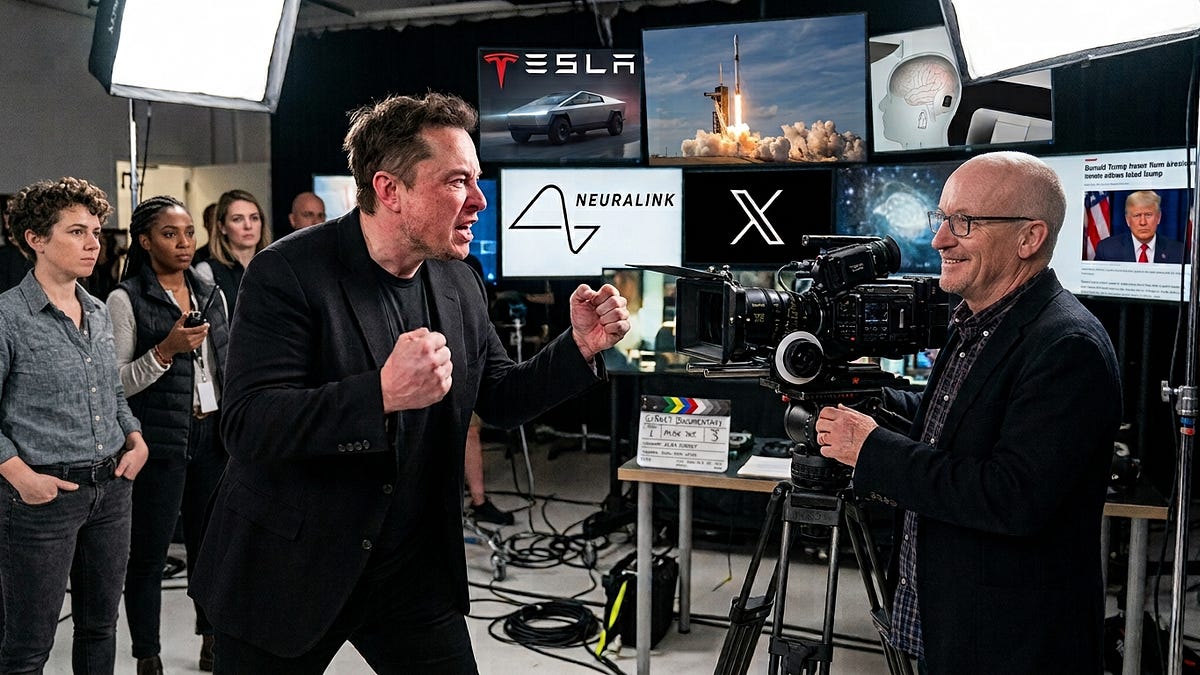
Alex Gibney's documentary Musk: A critical examination ofextraordinary power
The documentary at the center of the recent controversy is Musk, directed by Oscar-winning filmmaker Alex Gibney. Premiering at the Venice Film Festival in September 2026, the nearly four-hour film examines Musk's rise from technology entrepreneur to one of the world's most influential business figures.
The documentary traces Musk's involvement with Tesla, Space X, X (formerly Twitter), artificial intelligence, and the U.S. government's Department of Government Efficiency (DOGE). Its central concern is how his wealth, corporate reach,political relationships, and technological ambitions have combined to give him an unusual degree of influence over public life.
Gibney is known for documentaries investigating corporate misconduct, institutional power, and influential individuals. His previous work includes films about Enron, Lance Armstrong, and other controversial subjects. In Musk, he applies that investigative approach to a figure whose companies have helped shape electric vehicles, commercial spaceflight,satellite communications, and artificial intelligence.
The film is not a neutral celebration of technological achievement. It is a critical investigation that asks whether Musk'sgrowing power has outpaced the accountability mechanisms designed to constrain powerful individuals and corporations.
That distinction is important. The documentary presents a particular interpretation of Musk's career, built from interviews,public statements, archival material, and reported controversies. Its arguments deserve scrutiny alongside the evidence on which they rely and the responses of Musk and his representatives.
2. From technological visionary to a controversial center of power
One of the documentary's central questions is how public perceptions of Musk have changed over time.
For years, Musk was widely associated with ambitious technological projects that appeared to challenge established industries. Tesla helped accelerate the adoption of electric vehicles, while Space X developed reusable rockets and expanded commercial spaceflight. Starlink created a satellite-based internet service with applications ranging from remote connectivity to communications in conflict zones.
These achievements form an important part of the story. Gibney's film does not begin by treating Musk's entire career as afailure.
Instead, it examines the contrast between his technological accomplishments and the concerns that have emerged as his business and political influence has expanded.
The documentary raises several questions:
• Has Musk's ability to build successful technology encouraged the public to place excessive trust in his judgment?
• What happens when a business leader gains influence over essential communications infrastructure, public debate,and government operations?
• Are existing laws and institutions equipped to scrutinize a billionaire whose companies operate across so many sectors?
These are broader questions about private power, not merely personal criticisms of Musk.
The film's argument is that technological innovation does not automatically establish that a person should exercise substantial influence over public institutions. Supporters of Musk might counter that his willingness to take risks,challenge established practices, and invest in ambitious projects is precisely what has enabled his companies to achieve major breakthroughs.
The tension between those interpretations runs throughout the documentary.
3. The takeover of Twitter and the transformation of X
The acquisition of Twitter in 2022 is a major part of the documentary's examination of Musk's influence.
After purchasing the platform for approximately $44 billion, Musk renamed it X and introduced substantial changes to its operations, staffing, content policies, and verification systems.
Musk presented his ownership as an effort to promote free expression and change the way social media platforms moderated content.
Critics, however, raised concerns about inconsistent enforcement, the treatment of journalists, the spread of misleading information, and the concentration of control over a major communications platform in the hands of one individual.
Gibney's documentary uses the transformation of Twitter into X to explore the relationship between personal control and public discourse. A platform of this scale is not simply another private business: it can influence political communication,journalism, public debate, and the visibility of information during elections and international crises.
That does not mean every decision made by X is inherently harmful, nor does it establish that Musk alone determines what people believe. It does mean that decisions about platform rules and distribution can have consequences beyond the company's commercial interests.
The broader question raised by the film is whether a self-described commitment to free speech can be reconciled with concentrated private control over the systems through which millions of people communicate.
4. Tesla, Autopilot, and the consequences of technological risk
Another important theme is the responsibility that accompanies the development and marketing of advanced technology.
Tesla has played a significant role in popularizing electric vehicles and developing driver-assistance systems. These systems can help drivers with certain tasks, but their capabilities and limitations have been the subject of continuing public and regulatory scrutiny.
The documentary examines controversies surrounding Tesla's Autopilot technology and fatal crashes involving vehicles using driver-assistance features. It places these incidents within a broader discussion of how companies communicate technological capabilities, manage safety risks, and respond when products cause harm.
The distinction between a driver-assistance system and a fully autonomous vehicle is particularly important. Tesla's Autopilot and Full Self-Driving features have had different capabilities and operating requirements, and the availability of these features does not eliminate the driver's responsibility to supervise the vehicle.
Assessing individual crashes requires attention to the facts of each incident, including the system involved, driver behavior, road conditions, and investigative findings. A documentary's presentation of selected cases can raise legitimate questions, but it cannot replace a complete technical or legal investigation.
The broader issue is whether the commercial pressure to innovate rapidly can conflict with the need for rigorous safety testing, clear communication, and public accountability.
For viewers, this section connects the film's criticism of Musk's leadership style with a tangible question: who bears responsibility when ambitious technological promises meet real-world risks?
5. DOGE and the expansion of Musk's political influence
The documentary's political dimension is one of its most consequential subjects.
Musk became a prominent ally of Donald Trump during the 2024 presidential election and subsequently took a major role in the Department of Government Efficiency, known as DOGE. The initiative pursued reductions in federal spending,changes to government operations, and cuts to the federal workforce.
Supporters of the initiative argued that government agencies needed greater efficiency, less bureaucracy, and closer scrutiny of public expenditure. Critics raised concerns about the process by which changes were made, the effects on federal services, conflicts of interest, and the extent of authority exercised by a wealthy private citizen.
Gibney's film examines this period as a turning point in Musk's public role. Rather than focusing solely on his companies,it asks how his technological resources, wealth, and relationship with the Trump administration brought him closer to the machinery of government.
One particularly sensitive issue concerns access to government data. The film raises questions about information that DOGE personnel could access while reviewing federal systems and whether sufficient safeguards existed to protect sensitive information.
These are serious matters, but the questions posed in a documentary should not be mistaken for proof that information was improperly transferred or used. The available reporting identifies concerns and unanswered questions; allegations of specific wrongdoing require independent evidence.
The underlying public-interest issue is clear: when private-sector figures participate in government operations, the public needs to understand the scope of their authority, the information available to them, the safeguards in place, and the mechanisms for investigating potential conflicts of interest.
The documentary argues that Musk's influence should be examined within this larger institutional context rather than treated merely as a story about a wealthy entrepreneur's personality.
6. The controversial personal portrait
Beyond business and politics, Musk attempts to construct a portrait of Musk through interviews with people who have known or worked with him, including former associates, family members, journalists, and people connected to his personal life.
The film uses these perspectives to explore his ambitions, relationships, public persona, and approach to authority. Some interviewees offer critical assessments, while the documentary also draws on Musk's own recorded statements to show how he describes his goals and worldview.
One notable creative decision is that Musk did not sit for an interview with Gibney's team. Instead, the filmmakers created a computer-generated representation of him using his recorded words, with artificial intelligence helping synchronize the avatar's speech.
The approach allows the film to place Musk's public statements within its own narrative, but it also raises questions about the ethics of synthetic representations in documentary film making. Viewers must distinguish between a person's actual recorded statements and the artificial image used to present them.
The film's critical interpretation of Musk's personality is also a matter of editorial judgment. Interviews with former associates can provide valuable insight, but their claims should be assessed in light of corroborating evidence, possible conflicts, and the absence of other perspectives.
A documentary can reveal patterns and inconsistencies without necessarily providing a complete account of a person's private motivations. In Musk's case, the personal portrait is intended to help explain how his public influence has developed, but viewers should remain attentive to the distinction between documented conduct and interpretations of character.
7. Elon Musk's response: A “hit piece” or legitimate investigation?
Musk has responded aggressively to the documentary, making the dispute between the filmmaker and his subject part ofthe story itself.
Following the film's premiere at the Venice Film Festival in September 2026, Musk attacked Gibney on X, describing the documentary as a “hit piece” and questioning the director's integrity. He also criticized its nearly four-hour running time.Musk's lawyer threatened potential defamation litigation over aspects of the film, according to reporting by The Washington Post and The Guardian.
Gibney, meanwhile, has defended his work as an investigation into the accumulation of wealth and influence. In an interview with TIME, he argued that the film's critical conclusions emerged from his reporting rather than from a predetermined effort to discredit Musk.
The disagreement raises several important questions about investigative journalism and documentary film making.
• Editorial independence: Should filmmakers be free to investigate influential people without their subjects' approval?
• Fairness and accuracy: How should a documentary handle allegations, disputed interpretations, and statements from people who may have personal grievances?
• The right of reply: What weight should audiences give to the fact that Musk did not participate in an on-camera interview?
• Legal accountability: What standards should apply when a documentary makes claims that could damage an individual's reputation?
Musk's refusal to participate does not automatically invalidate the film. Likewise, the filmmaker's independence does not guarantee that every interpretation in the documentary is correct.
The strongest assessment requires examining the underlying evidence, the accuracy of the film's factual claims, and the responses offered by the people it discusses.
The dispute also illustrates a broader tension in public life: influential figures have legitimate interests in protecting their reputations, while journalists and filmmakers have a public-interest role in scrutinizing powerful individuals and institutions.
8. The controversy surrounding the film's distribution
The dispute has extended beyond the documentary's content to questions about whether it can be distributed and promote d widely.
According to the Associated Press, the film's promotional advertisements initially encountered refusals from severalmajor social media platforms, including YouTube, Meta, TikTok, and X. Some platforms subsequently reversed their decisions, attributing the original restrictions to political-content policies.
The issue attracted attention because Musk owns X, one of the platforms involved in the advertising controversy. It prompted debate about the relationship between privately controlled communications platforms, political content, and the ability of critical journalism to reach an audience.
It is important, however, to distinguish a platform's advertising decision from a ban on the film itself. Restrictions on paid promotion do not necessarily prevent a documentary from being available through theaters or other distribution channels.
The film also faced uncertainty over its international release. In an October 12 report, The Guardian said Gibney had expressed concern that Universal Pictures, which held international distribution rights, had hesitated over the rollout. The studio maintained that it remained committed to releasing the documentary, and Gibney indicated that discussions were progressing.
These developments raise legitimate questions about the commercial pressures surrounding politically sensitive documentaries. They do not, by themselves, establish that a coordinated effort to suppress the film occurred.
The larger concern is whether a small number of powerful companies can significantly shape the public visibility of criticism directed at influential business leaders.
9. What the documentary contributes to the debate over billionaire power
Perhaps the most significant aspect of Musk is that its questions extend beyond Musk himself.
The film invites viewers to consider the responsibilities that accompany concentrated private wealth, particularly when an individual has interests spanning technology, transportation, communications, artificial intelligence, and government policy.
Several broader issues emerge.
First, technological success and public accountability are separate questions. A company can develop valuable products while still requiring independent oversight of its safety practices, labor conditions, business conduct, or effects on society.
Second, private infrastructure can have public consequences. Satellite networks, social media platforms, electric vehicles,and AI systems increasingly influence everyday life. Decisions made by their owners can affect people who have little direct control over those decisions.
Third, government relationships require transparency. When business leaders participate in public administration or maintain close relationships with political leaders, the public has an interest in understanding how authority is exercised and whether appropriate safeguards exist.
Fourth, criticism of powerful people requires reliable evidence. A compelling narrative is not a substitute for documentation, independent verification, or a fair opportunity to respond.
These principles apply beyond Musk. They are relevant to other technology executives, major corporations, government contractors, and influential individuals whose decisions can affect large sections of society.
The documentary's value therefore lies not simply in its portrayal of one billionaire but in the questions it raises about the institutions that govern modern technological and economic power.
10. How viewers should evaluate the film
For audiences considering Musk, the most productive approach is to treat it as an investigative argument rather than a definitive biography.
Viewers can ask several questions while watching:
• Which claims are supported by documents, recordings, public records, or independently corroborated reporting?
• Which conclusions depend primarily on interviews with former associates or other people who may have particular perspectives?
• Does the documentary distinguish between established facts, allegations, and speculation?
• Does it adequately acknowledge Musk's technological achievements and the arguments made by his defenders?
• How do its central claims compare with independent reporting, regulatory findings, court records, and responses from Musk or his companies?
These questions do not require viewers to accept or reject the film as a whole. They provide a framework for evaluating its evidence and deciding which conclusions are persuasive.
The documentary's nearly four-hour running time reflects its ambition to connect Musk's business career, personal relationships, political involvement, and technological influence into one narrative. That scope may help audiences recognize connections that are difficult to see when these subjects are considered separately.
At the same time, any documentary covering such a broad subject must make editorial choices about what to include,which voices to prioritize, and how to interpret events. Those choices deserve scrutiny, particularly when the film makes critical claims about a highly influential person.
Conclusion: A documentary about Elon Musk—and the power he represents
Alex Gibney's Musk has become a significant cultural and political talking point because it examines a figure whose influence extends well beyond the technology sector.
By connecting Tesla and Space X with X, artificial intelligence, and Musk's involvement in the Trump administration, the documentary presents a critical account of how private wealth and technological innovation can translate into broader political and social power.
Musk's response has intensified the controversy, while the film's distribution difficulties have raised additional questions about media independence and the influence of large technology companies.
Yet the most important question is not whether viewers agree with every criticism made by Gibney. It is whether the documentary encourages a more informed examination of the responsibilities, risks, and accountability mechanisms associated with extraordinary private power.
Musk's defenders can reasonably point to his companies' technological achievements and argue that ambitious innovation requires risk-taking and unconventional leadership. Critics can reasonably argue that those achievements do not exempt a business leader from scrutiny over safety, corporate decisions, political influence, or public responsibilities.
Both perspectives can be examined through evidence rather than personality or partisan loyalty.
Ultimately, Musk offers a critical interpretation of a consequential public figure. Its lasting significance will depend on how well its claims withstand independent examination—and whether the questions it raises lead to a deeper public understanding of the relationship between technology, wealth, government, and democracy.
 102852