
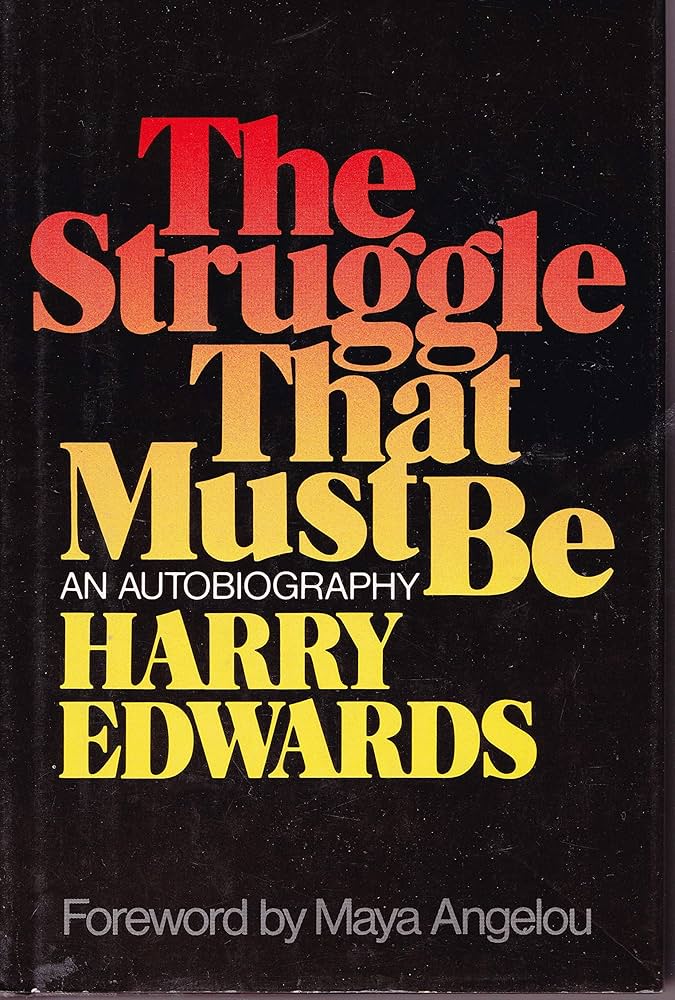
Synopsis of "The Struggle That Must Be" Book
The Struggle That Must Be is the powerful autobiography of Harry Edwards, a pioneering sociologist, activist, and architect of the modern movement linking sports with social justice. In this deeply personal and political narrative, Edwards traces his life from a childhood marked by poverty and racial inequality to his emergence as a leading voice in the fight for Black empowerment, particularly within the world of athletics. The book is both a memoir and a manifesto, arguing that struggle is not only inevitable but necessary for meaningful social change.
Edwards begins by recounting his early life in East St. Louis, Illinois, a city plagued by economic decline, segregation, and limited opportunities for Black residents. Growing up in a working-class family, he experienced firsthand the harsh realities of systemic racism. His childhood was shaped by instability, violence, and the constant pressure to survive in an environment that offered little support or hope. These early experiences instilled in him a deep awareness of injustice and laid the foundation for his later activism.
Sports played a significant role in Edwards’s youth, providing both an escape from his surroundings and a pathway to opportunity. Like many young Black men of his time, he saw athletics as one of the few viable routes to success. However, even as he excelled physically, Edwards began to recognize the contradictions inherent in the system. While Black athletes were celebrated for their performance on the field, they were often denied respect, equality, and basic rights off it. This realization would become central to his life’s work.
After serving in the military, Edwards pursued higher education, eventually earning a scholarship to attend college. His academic journey exposed him to new ideas and frameworks for understanding race, power, and inequality. Influenced by the broader Civil Rights Movement and the emerging Black Power Movement, Edwards began to see sports not just as a personal opportunity, but as a platform for political expression and social change. He became increasingly convinced that athletes had both the visibility and the responsibility to challenge injustice.
A major turning point in Edwards’s life came during his time at San Jose State University, where he worked as a sociology instructor. There, he began organizing Black student-athletes and raising awareness about the exploitation and marginalization they faced. Despite generating significant revenue and prestige for their institutions, many Black athletes were denied proper education, treated as disposable, and subjected to discriminatory practices. Edwards sought to expose these inequities and push for systemic reform.
This activism culminated in the creation of the Olympic Project for Human Rights (OPHR), an organization Edwards founded to protest racial injustice in sports and society. The OPHR called for a boycott of the 1968 Olympic Games unless certain demands were met, including the restoration of Muhammad Ali’s boxing title (after he was stripped of it for refusing military service), the removal of apartheid South Africa and Rhodesia from international competition, and the hiring of more Black coaches and administrators.
Although the full boycott did not materialize, the movement gained international attention and set the stage for one of the most iconic moments in sports history: the Black Power salute at the 1968 Olympics in Mexico City. U.S. sprinters Tommie Smith and John Carlos raised their gloved fists during the medal ceremony to protest racial injustice and express solidarity with oppressed people worldwide. Edwards was a key figure behind this act, helping to conceptualize and support the protest.
The aftermath of the protest illustrates one of the central themes of the book: the cost of resistance. Smith and Carlos faced severe backlash, including public condemnation, death threats, and the loss of their athletic careers. Edwards himself was heavily criticized and surveilled. Through these experiences, he emphasizes that “the struggle” is not abstract—it involves real risks, sacrifices, and consequences. Yet he also argues that such actions are essential for progress, as they force society to confront uncomfortable truths.
Throughout the book, Edwards challenges the myth that sports exist separate from politics. He argues that sports are deeply embedded in social structures and reflect broader inequalities related to race, class, and power. He critiques the idea that athletic success alone can uplift Black communities, pointing out that only a small percentage of athletes achieve long-term success, while many others are left without education or career prospects. For Edwards, the glorification of sports can sometimes serve as a distraction from more systemic issues.
Another key theme is the concept of exploitation. Edwards describes how Black athletes are often used as tools to generate profit and prestige for predominantly white institutions, without receiving fair compensation or support. He highlights the imbalance of power between athletes and those who control the systems they operate within, including coaches, administrators, and governing bodies. This critique remains highly relevant in contemporary discussions about college athletics and athlete compensation.
In addition to examining institutional issues, Edwards reflects on his own personal growth and struggles. He does not present himself as a flawless hero, but rather as someone shaped by hardship, mistakes, and learning experiences. He acknowledges moments of doubt, conflict, and failure, offering a nuanced and honest portrayal of what it means to dedicate one’s life to a cause. This introspection adds depth to the narrative and reinforces the idea that struggle is both external and internal.
The book also situates Edwards’s work within the broader context of the Civil Rights and Black Power movements. He draws connections between his efforts in sports and the larger fight for equality in American society. By doing so, he underscores the interconnectedness of different forms of activism and highlights the role of athletes as part of a wider movement for justice.
As the narrative progresses, Edwards discusses the long-term impact of his work and the evolving role of athletes in social activism. He reflects on how the actions of the 1960s helped pave the way for future generations to speak out on issues such as racism, inequality, and human rights. While progress has been made, he emphasizes that many of the same challenges persist, making the struggle ongoing.
The title of the book, The Struggle That Must Be, encapsulates Edwards’s central message: that struggle is not optional, but necessary. Change does not occur passively; it requires effort, resistance, and a willingness to confront injustice, even in the face of opposition. For Edwards, struggle is both a burden and a source of strength—it is what drives individuals and communities to push beyond limitations and demand a better future.
In conclusion, The Struggle That Must Be is a compelling and thought-provoking account of one man’s journey through adversity, activism, and transformation. It offers valuable insights into the intersection of sports and society, the realities of racial inequality, and the power of collective action. Through his story, Harry Edwards challenges readers to reconsider the role of athletes, the meaning of success, and the importance of standing up for what is right. Ultimately, the book serves as a reminder that progress is never given—it must be fought for, and that fight is the struggle that must be.
 10420
10420